
Key Takeaways
- Soybeans need different irrigation than corn due to their indeterminate growth pattern – treating them the same causes water waste and yield loss
- Overwatering leaches nitrogen fertilizer from the root zone, reducing efficiency by up to 32% and polluting groundwater
- Soil moisture sensors should track long-term trends rather than daily readings to prevent over-irrigation
- Adjust irrigation refill points throughout the season as roots deepen and water needs change at different growth stages
- Regular system maintenance prevents uneven water distribution that can reduce yields by 7-30 bushels per acre
- Real-time field data from sensors beats assumptions about neighboring fields due to varying soil types and microclimates
Article Summary: Midwest farmers commonly make six critical smart irrigation mistakes that reduce efficiency and yields: treating soybeans like corn, overwatering that leaches nitrogen, irrigating before rainfall, failing to adjust settings mid-season, poor equipment maintenance, and relying on assumptions instead of field-specific sensor data.
Are Any of These Familiar?
- Treating soybeans like corn (using the same irrigation strategy for both crops)
- Overwatering leading to nutrient leaching
- Irrigating before forecasted rainfall
- Not adjusting irrigation strategy mid-season
- Poor irrigation system maintenance
- Relying on assumptions instead of field-specific data
Why Midwest Soybean Irrigation Fails More Often Than It Should
Smart irrigation technology has transformed farming across the Midwest, but many producers still struggle to see the yield gains they expected when they invested in these systems. The problem is not the technology itself – it is how farmers use it.
Midwest soybeans respond differently to irrigation than corn, yet most farmers water both crops using identical strategies. This fundamental mistake, combined with poor sensor placement, ignored weather data, and static irrigation schedules, costs farmers thousands of dollars each season in wasted water, lost fertilizer, and reduced yields.
The Midwest presents unique challenges for irrigation management. Variable weather patterns, diverse soil types ranging from sandy loams to heavy clays, and the region’s characteristic humid summers create conditions vastly different from the arid West where many irrigation practices originated. What works in Nebraska or Kansas may not translate directly to Illinois, Iowa, or Michigan farms.
Understanding these regional differences and the specific water needs of soybeans at each growth stage helps farmers maximize their irrigation investment while conserving water and protecting the environment. Let’s examine the most common mistakes and the practical solutions that work in real Midwest fields.
Mistake 1: Irrigating Soybeans Like Corn
The single biggest irrigation mistake Midwest farmers make is applying the same watering schedule to soybeans that they use for corn. This error stems from convenience and habit, but it costs money.
Why This Mistake Happens
Corn has dominated Midwest farming for decades, and most irrigation systems were originally designed with corn in mind. When farmers rotate to soybeans, they often keep the same irrigation settings, timing, and frequency. After all, both are row crops growing in the same soil, right?
Wrong. Soybeans and corn have fundamentally different growth patterns and water requirements that demand distinct irrigation approaches.
The Critical Difference in Growth Patterns
Corn exhibits determinate growth – vegetative growth stops when the plant tassels and begins forming ears. The plant’s nutrient uptake happens in a concentrated burst just before the reproductive stage begins. This makes corn irrigation relatively straightforward to schedule.
Soybeans, however, have an indeterminate growth pattern. Vegetative growth continues even after flowering starts, and nutrient uptake matches biomass production throughout the entire season.[1] This means soybean water needs change gradually rather than in distinct phases, requiring a more nuanced irrigation approach.
The most critical period for soybean irrigation runs from R3 (beginning pod) through R6 (full seed), typically occurring from late July through early August in most Midwest locations. During this window, soybeans need substantial water – approximately 0.35 inches per day – to properly fill pods and maximize seed size.[6] Missing this window significantly impacts final yields.
How to Fix This Problem
Follow soybean-specific irrigation strategies based on growth stage rather than copying your corn schedule. Michigan State University Extension recommends managing irrigation differently for soybeans, particularly during the reproductive phases when pod retention and seed fill determine final yields.[1]
Early in the season before R3, soybeans can tolerate greater soil water deficits – up to 70-75% depletion – without yield loss.[7] This conservative early approach encourages deeper root development and reduces water and energy costs. However, once plants reach R3, maintain soil moisture at 50% or higher of available water capacity through R6 to maximize pod retention and seed size.
Best suited for: Any farmer rotating corn and soybeans under center pivot or other mechanized irrigation systems. This adjustment requires no new equipment – just attention to crop stage and willingness to manage the two crops differently.
| Growth Stage | Corn Irrigation Approach | Soybean Irrigation Approach | Key Difference |
|---|---|---|---|
| Early Vegetative | Maintain 50% soil moisture | Can tolerate 70-75% depletion | Soybeans more drought tolerant early |
| Flowering/Pollination | Critical period – frequent irrigation | Moderate water needs, 100% crop ET | Corn more sensitive to stress here |
| Pod/Ear Fill | High water needs continue | MOST CRITICAL – 120% crop ET, R3-R6 | Soybeans peak later in season |
| Maturity | Reduce to black layer | Continue through R6, then reduce | Timing of final irrigation differs |
Mistake 2: Overwatering and Nutrient Leaching
Applying too much irrigation water seems like playing it safe, but overwatering creates serious agronomic and environmental problems that directly impact your bottom line.
The Hidden Cost of Excess Water
When you apply more water than the soil can hold in the active root zone, the excess percolates downward, carrying dissolved nutrients with it. Nitrogen fertilizer, which you paid good money for, leaches below the root zone where plants cannot access it. Research shows that over-irrigation can increase nitrogen loss by 16 to 32 percent compared to properly managed systems.[3]
This nitrogen does not simply disappear – it pollutes groundwater, contributing to elevated nitrate levels that affect drinking water quality throughout the Midwest. In agricultural areas, nitrate leaching from irrigated fields represents a significant water quality concern.
Beyond Fertilizer Loss
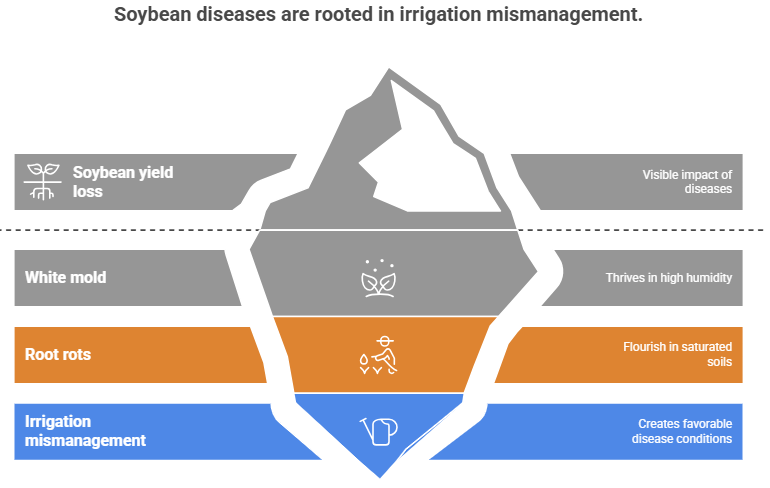
Saturated soils also create favorable conditions for root diseases. Soybean diseases like Phytophthora root rot and white mold thrive in overly wet conditions. Maintaining constantly saturated soils invites these pathogens, potentially causing more damage than drought stress would have.
Overwatering also reduces soil oxygen levels. When soil pores fill with water rather than air, root respiration suffers. Research demonstrates that corn and soybean yields can drop by 7 to 30 bushels per acre when fields experience extended periods of saturated conditions, even without visible flooding.[3]
How to Fix This Problem
Install soil moisture sensors at multiple depths in the root zone – typically at 6, 12, 18, and 24 inches for soybeans. Place sensors in representative areas of each field, avoiding atypical spots like low areas, near pivot roads, or in shade.
Track moisture trends over several days rather than reacting to single daily readings. Look at the pattern of soil water depletion to understand how quickly your crop uses water under current weather conditions. This trend analysis prevents the common mistake of irrigating based on a single dry sensor reading that may not represent the whole field.
Maintain soil moisture between 50-60% of available water capacity during critical growth stages. Avoid “topping off” irrigation to field capacity before forecasted rainfall. University of Minnesota research shows that this practice often results in unnecessary leaching, especially on sandy soils common in parts of the Midwest.[2]
Best suited for: Farmers on sandy or sandy loam soils where leaching risk is highest, and those in areas with groundwater quality concerns. The initial investment in quality sensors pays for itself through fertilizer savings and yield protection.
Mistake 3: Irrigating Before Rainfall
Midwest weather patterns differ dramatically from the arid regions where many irrigation practices originated. The region receives substantial rainfall during the growing season, yet many farmers irrigate as if they farm in western Nebraska or Kansas.
Why the “Top Off” Strategy Fails
Many farmers attempt to “top off” their soil moisture levels ahead of forecasted rain. The logic seems sound – ensure the crop has enough water no matter what happens. However, this approach backfires when the predicted rain actually arrives.
When you irrigate a field that already has adequate moisture and then receive significant rainfall, the excess water cannot be stored in the soil profile. It either runs off the surface or percolates below the root zone, carrying valuable nutrients with it. On center pivot systems that apply 0.75 to 1.0 inch per pass, adding this water right before a substantial rain event wastes energy, water, and fertilizer.
Understanding Midwest Rainfall Patterns
Indiana averages 34 inches of rainfall annually, with much of it falling during the growing season. Illinois and Iowa receive similar amounts. Michigan’s rainfall is even more generous. These are not arid climates where every drop of water must be captured and conserved.
Late June and early July rainfall events in Michigan and Indiana often refill the soil profile completely, especially on soils with good water-holding capacity.[4] This natural recharge allows farmers to start fresh as crops enter their peak water demand periods in mid-to-late July.
How to Fix This Problem
Integrate real-time weather data into your irrigation decisions through systems like Michigan State University’s Enviroweather or local weather stations. Check rainfall forecasts daily during the irrigation season, paying attention to both predicted amounts and probability.
If significant rain – typically 0.5 inches or more – shows 70% or higher probability within the next 24-48 hours, delay irrigation and verify soil conditions with sensors after the rain event. Your sensors will show you exactly how much moisture the rain added to your specific field and soil type.
Create at least 1 inch of available water-holding capacity in the soil profile before predicted rainfall events. If reference evapotranspiration is running 0.2 inches per day, this means waiting approximately five days after your last irrigation before a forecasted rain event to capture that water efficiently.[4]
Best suited for: All Midwest farmers, but especially those in higher rainfall areas like Michigan, eastern Iowa, Illinois, and Indiana. This practice requires discipline to override the urge to “play it safe” by irrigating early, but it pays dividends in reduced costs and better nutrient retention.
| Scenario | Typical Farmer Response | Better Approach | Outcome |
|---|---|---|---|
| 20% chance of rain forecasted | Irrigate as planned | Irrigate as planned | Correct decision – low probability |
| 50% chance of 0.3″ rain | Top off with irrigation | Wait 12-24 hours, check sensors | Avoid potential over-irrigation |
| 70% chance of 0.8″ rain | Irrigate “just in case” | Skip irrigation, monitor sensors after rain | Save water, energy, prevent leaching |
| 90% chance of 1.5″ rain | Some still irrigate | Definitely skip, plan next irrigation based on post-rain sensor readings | Major savings, reduced nutrient loss |
Mistake 4: Not Adapting Irrigation Strategy Mid-Season
Setting your irrigation controller at the start of the season and leaving it unchanged until harvest seems efficient, but this “set it and forget it” mentality costs yields and wastes resources.
How Root Development Changes Everything
Early in the season, soybean roots concentrate in the top 12 inches of soil. By mid-season, a healthy soybean plant develops an effective rooting depth of 24-30 inches, with some roots extending to 5 feet in ideal conditions. Corn roots follow a similar deepening pattern.
This root development progression means the volume of soil your crop can extract water from increases substantially as the season progresses. Yet many farmers maintain the same refill point – the soil moisture level that triggers irrigation – throughout the entire growing season.
Early Season Water Management
When roots are shallow, irrigating to deeper depths wastes water by wetting soil below the active root zone. Worse, maintaining high soil moisture early in the season can actually reduce final yields by encouraging shallow root development. Plants that always find water near the surface have little incentive to develop deep root systems.
Lyndon Kelley, irrigation educator with Michigan State University Extension and Purdue University, notes that soybeans can tolerate up to 75% soil water deficit before the R3 growth stage without experiencing yield loss.[7] This tolerance allows for water conservation early in the season while promoting deeper root growth.
Peak Season Adjustments
As soybeans enter the R3 through R6 stages – beginning pod through full seed – water requirements increase dramatically to approximately 1.6 inches per week during hot conditions. The crop coefficient during this period reaches 1.2, meaning soybeans use 120% of reference evapotranspiration.[8]
During these critical weeks, maintaining adequate soil moisture becomes paramount. However, the deeper root system now allows you to manage a larger soil moisture reservoir, potentially reducing irrigation frequency while applying larger volumes per application.
How to Fix This Problem
Adjust your irrigation refill points at least three times during the growing season: early vegetative, reproductive stages, and late season. Use your soil moisture sensors to visualize root zone depth by observing which depths show water extraction.
Early season (before R3): Allow soil moisture to deplete to 70-75% before irrigating, focusing water application on the top 12-15 inches. This encourages deeper rooting while conserving water and energy.
Mid-season (R3 through R6): Tighten your refill point to 50% soil water depletion and manage the top 24-30 inches of soil. Increase application depths to wet at least half the rooting depth with each irrigation event.
Late season (after R6): Reduce irrigation frequency as crop water use declines to 0.04-0.05 inches per day. Monitor sensors to maintain at least 50% available water until pods reach mature color.
Best suited for: Farmers with variable rate irrigation capabilities on their center pivots, though these adjustments can be made manually on any system. Growers managing multiple fields with varying soil types benefit most from field-specific adjustments.
Mistake 5: Poor Irrigation System Maintenance
Smart controllers and advanced sensors cannot compensate for clogged nozzles, leaking valves, or malfunctioning pressure regulators. Even the most sophisticated irrigation management fails when the physical system does not deliver water uniformly.
The Compounding Effect of Small Problems
A single clogged sprinkler nozzle on a center pivot might seem insignificant, but multiply that problem across multiple spans and you create zones of under-watered crops alongside areas receiving proper moisture. Your sensors might show adequate moisture in one location while plants 200 feet away suffer from drought stress.
Pressure irregularities cause similar problems. When system pressure drops below design specifications – often due to worn pump components, leaking connections, or partially closed valves – flow rates decrease and coverage patterns change. What was designed as uniform coverage becomes spotty and inconsistent.
Maintenance Issues Specific to Midwest Conditions
Midwest groundwater often contains elevated levels of iron, calcium, and other minerals. These minerals precipitate out inside pipes, valves, and especially drip emitters or micro-sprinklers, gradually reducing flow rates over time. Unlike the harder, more visible failures like broken pipes, this gradual degradation goes unnoticed until crop symptoms appear.
Debris in surface water sources presents another challenge. Ponds, creeks, and rivers carry organic matter and sediment that can clog filters and emitters. During spring high water periods, sediment loads increase substantially, requiring more frequent filter maintenance than farmers typically anticipate.
How to Fix This Problem
Establish a regular maintenance schedule rather than waiting for problems to become obvious. Inspect your entire system at least monthly during the irrigation season, and conduct a thorough pre-season check before turning on the water each spring.
Weekly maintenance tasks: Clean or backflush filters, check for visible leaks at connections, verify that all sprinklers or emitters are operating, and monitor system pressure at multiple points.
Monthly maintenance tasks: Walk or drive the entire length of pivot systems checking for alignment issues, test pressure regulators at multiple zones, inspect electrical connections for corrosion, and verify that all end guns and corner systems activate properly.
Conduct a uniformity test on center pivot systems every 2-3 years. These tests measure how evenly water is distributed across the irrigated area, identifying problems that are not obvious during casual observation. Clemson University’s Center Pivot Irrigation Test Program reports that many systems have uniformity issues that reduce efficiency by 10-20% before farmers notice problems.[10]
For systems drawing from surface water or wells with high mineral content, implement a water quality management program. This might include acid injection for mineral precipitation control, regular flushing protocols, or installation of appropriate filtration equipment.
Best suited for: Every farmer using irrigation equipment, regardless of system type or size. Maintenance is not optional – it is fundamental to getting returns on your irrigation investment. Drip and micro-irrigation systems require especially diligent maintenance due to their vulnerability to clogging.
Mistake 6: Relying on Assumptions Instead of Data
Modern smart irrigation systems provide unprecedented amounts of data about soil moisture, weather conditions, and crop water use. Yet many farmers still make irrigation decisions based on assumptions, rules of thumb, or what the neighbor is doing.
Why Neighboring Fields Differ More Than You Think
Two fields separated by a fence line can have dramatically different irrigation needs due to soil type variations, slope differences, residue management, or planting date. A field on sandy loam soil with 2.2 inches of available water per foot holds roughly 40% less water than an adjacent field on silt loam with 2.6 inches per foot of available water capacity.
These differences compound over the season. The sandy field requires more frequent irrigation applications to maintain adequate moisture, while the silt loam field can go longer between irrigation events. Treating both fields identically results in overwatering the heavier soil or underwatering the lighter soil.
Microclimate variations also play a significant role. Fields with different aspects, elevation changes, or windbreak protection experience different rates of evapotranspiration even when planted to the same crop on the same day.
The Cost of Generic Recommendations
Extension publications and irrigation guides provide valuable information, but they offer generalized recommendations that must be adapted to specific field conditions. When you see advice like “apply 1 inch of water per week,” that assumes average soil, average weather, and average crop development.
Your field probably does not match all those averages. The actual water need might be 0.7 inches or 1.4 inches depending on the specific combination of factors affecting your crop at that moment. Generic recommendations provide a starting point, but field-specific data refines that estimate to match reality.
How to Fix This Problem
Invest in and actually use field-specific monitoring tools. At minimum, install soil moisture sensors in representative locations within each irrigated field. Place sensors at multiple depths to track water movement through the root zone. Supplement these with local weather data from the nearest reliable station or on-farm weather monitoring equipment.
Learn to interpret your sensor data as trends rather than absolute values. A single reading tells you little; a week of readings shows you how quickly water is being depleted, whether irrigation is reaching the desired depth, and if your current strategy is maintaining moisture in the optimal range.
Compare data across fields rather than assuming all fields need the same treatment. You may find that Field A requires irrigation every 4 days while Field B on heavier soil needs irrigation only every 6 days, even though both are growing the same variety planted on the same date.
Integrate multiple data sources into decisions. Combine soil moisture sensor readings, weather data, crop stage observations, and historical irrigation records to develop a complete picture. Michigan State University’s Irrigation Management Assistant and similar tools help farmers synthesize this information into field-specific recommendations.
Best suited for: All farmers, but especially those managing multiple fields with varying soil types or those farming in areas with variable topography. The initial investment in sensors and monitoring equipment pays for itself through improved irrigation timing and reduced waste.
Common Disease Risks From Irrigation Mistakes
Improper irrigation management does not just waste water and money – it creates favorable conditions for destructive soybean diseases that can devastate yields.
White Mold Thrives on Excess Moisture
White mold represents one of the most significant disease threats to irrigated soybeans in the Midwest. The fungus requires extended periods of high humidity and free moisture on plant surfaces to infect soybeans.[1] Frequent, light irrigation applications that keep plant canopies wet create ideal infection conditions.
To reduce white mold risk while maintaining adequate irrigation, apply larger volumes of water less frequently rather than making multiple small applications.[1] This approach provides the water crops need while reducing the hours of leaf wetness that favor disease development.
Root Rots Love Saturated Soils
Phytophthora root rot, Rhizoctonia root rot, and sudden death syndrome all develop more readily in fields with poor drainage or overly saturated soils. These soilborne pathogens exploit periods when soil oxygen levels drop due to excess water.
Maintaining proper soil moisture levels – typically 50-60% of available water capacity during reproductive stages rather than constant saturation – helps suppress these diseases while still providing adequate water for optimum yields.
Regional Considerations for Midwest Irrigation
The Midwest spans diverse climatic zones from Illinois to the Dakotas, and irrigation strategies must account for these regional differences.
Eastern Corn Belt
Indiana, Ohio, Illinois, and Michigan typically receive more rainfall during the growing season, but that rainfall often comes at the wrong times. Early season moisture may be abundant, while mid-to-late summer can turn dry precisely when soybeans need water most for pod fill.
Farmers in these states should focus on capturing and storing early season rainfall in the soil profile, then using strategic irrigation to bridge mid-summer dry periods. Installing sensors and using weather-based scheduling prevents wasting water during times when rainfall is likely.
Western Corn Belt
Iowa, Nebraska, and South Dakota farms face different challenges with more variable rainfall patterns and higher evapotranspiration rates due to lower humidity and stronger winds. Center pivot irrigation is more common here, and managing the system to avoid over-application becomes critical for both water conservation and preventing nutrient loss.
Research from the University of Nebraska demonstrates that proper irrigation scheduling in this region can reduce seasonal water application by one inch per acre while maintaining full yield potential, a significant savings multiplied across hundreds or thousands of acres.[9]
Conclusion
Smart irrigation technology offers Midwest soybean farmers powerful tools to increase yields, conserve water, and protect profits, but only when used correctly. The six mistakes we covered – treating soybeans like corn, overwatering, irrigating before rain, static scheduling, poor maintenance, and relying on assumptions – remain surprisingly common even among experienced farmers who invested thousands in advanced equipment.
The good news? Every one of these problems has a straightforward solution that requires changing management practices rather than buying new equipment. Start by treating your soybeans as the unique crop they are, with water needs that differ from corn throughout the season. Install quality sensors and actually use the data they provide. Maintain your equipment diligently, and adjust your irrigation strategy as crops grow and seasons progress.
You invested in smart irrigation to improve your operation. Take control of these common mistakes, implement the fixes we outlined, and you will see the returns you expected when you made that investment. Your crops, your water resources, and your bottom line will all benefit from irrigation management that is truly smart, not just technologically advanced.
Smart Irrigation Mistakes Midwest Farmers Still Make FAQs
How often should I calibrate my soil moisture sensors for smart irrigation for soybean crops?
You should calibrate soil moisture sensors at least once per season, preferably at the beginning of the growing season before planting or immediately after planting. Sensors can drift over time due to soil settling, mineral buildup, or temperature fluctuations. If you notice readings that do not align with observed field conditions or hand-feel soil moisture checks, recalibrate immediately regardless of when you last calibrated.
What is the biggest smart irrigation mistake Midwest farmers make with soybean crops?
The biggest mistake is irrigating soybeans using the same schedule and approach as corn. Soybeans have an indeterminate growth pattern with water needs that peak later in the season during the R3 through R6 reproductive stages. Treating soybeans like corn wastes water early and risks under-watering during the critical pod fill period when moisture stress has the greatest impact on final yields.
Can smart irrigation systems reduce nitrogen leaching in soybean fields?
Yes, properly managed smart irrigation systems can significantly reduce nitrogen leaching. Systems that avoid over-irrigation and maintain soil moisture at 50-60% of available water capacity prevent excess water from pushing nitrate below the root zone. Research shows that scientific irrigation scheduling methods reduce nitrate leaching risk compared to traditional methods, with potential reductions of 16-32% in nitrogen loss on properly managed systems.
When should I stop irrigating my soybean crop in the Midwest?
Stop irrigating soybeans when plants reach R7 stage, defined as when at least 50% of pods on the plant have reached mature pod color.[5] At this stage, soybean water use drops to less than 0.04 inches per day. Irrigating beyond R7 wastes resources without adding yield. Use soil moisture sensors to verify that the soil profile maintains at least 50% available water through R6, then gradually reduce irrigation as plants approach R7.
How do I know if my center pivot system needs maintenance?
Conduct a visual inspection monthly during the irrigation season looking for uneven crop growth patterns, which often indicate distribution problems before equipment failure becomes obvious. Check for visible leaks at connections, verify all sprinklers are operating, and monitor system pressure. Schedule a professional uniformity test every 2-3 years to measure water distribution accuracy. If uniformity drops below 85%, identify and correct the underlying problems before they significantly impact yields.
Smart Irrigation Mistakes Midwest Farmers Still Make Citations
[1] Michigan State University Extension – Soybean Irrigation Management
[2] University of Minnesota Extension – Late-Season Irrigation
[3] University of Nebraska-Lincoln Extension – Avoiding Over-Irrigation
[4] Michigan State University Extension – Scheduling Tools Help Irrigators
[5] Michigan State University Extension – Answers to Common Questions About Irrigating Soybeans
[6] University of Nebraska-Lincoln Extension – Irrigating Soybean
[7] Wisconsin Soybean Extension – Early Season Soybean Irrigation
[8] Michigan State University Extension – Soybeans at R-3 Benefit from Ample Water
[9] University of Nebraska CropWatch – Agronomic Management for Reduced Nitrate Leaching
[10] Farm Progress – Center Pivot Checkups





Leave a Reply