
Subsurface Drip Irrigation
-
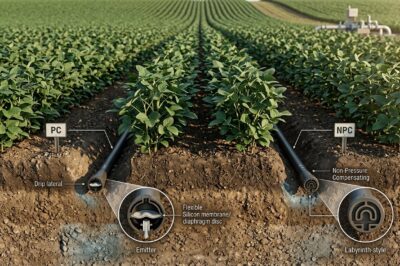
Pressure Compensating vs Non-PC Emitters for Soybean SDI: When You Need PC and When You Don’t
Key Takeaways Pressure compensating vs non-PC emitters for soybean SDI is a hydraulics question with a clear answer in most situations: if your soybean field has meaningful slope along the lateral direction, you need PC emitters. If your field is flat to very gently sloping and your lateral runs are within the hydraulically designed length…
-
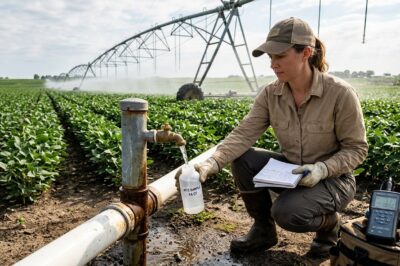
Irrigation Water Quality Testing for Soybeans: What to Test, How to Interpret Results, and When to Act
Key Takeaways Irrigation water quality testing for soybeans answers a question that soil testing and yield mapping can’t: is the water you’re applying a neutral carrier for your irrigation program, or is it accumulating salt, sodium, scale-forming minerals, or clogging agents that are progressively degrading your soil, your irrigation system, or both? For most Midwest…
-

Netafim SDI Systems: How to Evaluate a Commercial Dealer for Soybean Installations
Key Takeaways: Netafim invented commercial drip irrigation and remains the technology leader in the category globally. Their Streamline, Uniram, and CNL dripline products represent genuine engineering advancement in emitter technology, clog resistance, and wall thickness options relative to the broader drip tape market. But a Netafim authorization does not make a dealer competent at commercial…
-

SDI Clogging Prevention for Soybean Drip Irrigation: The Three Failure Mechanisms and How to Stop Them
Key Takeaways SDI clogging prevention for soybean drip irrigation determines whether a $400,000 SDI system delivers its full 15–20 year design life or begins losing performance within three to five seasons. Unlike surface drip systems where emitter clogging is visible and individually correctable, clogging in a buried SDI system is invisible until it has progressed…
-

Irrigation Dealer vs. Direct-to-Farm Purchase: How to Evaluate Channel Options When Buying Commercial SDI Components
Key Takeaways Irrigation dealer vs. direct purchase for soybean SDI comes down to one question: what is the cost of getting it wrong? For commodity consumables with fixed specifications, getting it wrong means buying the wrong emitter spacing or wall thickness — a correctable mistake with a modest cost. For complex capital infrastructure like pump…
-

Pump Station Automation Controllers for Large-Scale Soybean SDI: What to Specify and Why
Key Takeaways Pump station automation controllers for soybean SDI are the piece of infrastructure that makes precision irrigation work at scale. A Cropwise platform can calculate the perfect ET-based irrigation prescription for a 400-acre soybean field. A Netafim NavNet system can wirelessly command 40 zone valves to open in the correct sequence. But if the…
-

Subsurface Drip Irrigation Tape Depth and Spacing Guidelines for Commercial Soybean Row Crop Production
Key Takeaways Subsurface drip tape depth and spacing for soybeans is the foundational design decision that determines whether a buried SDI system delivers consistent yield improvement for 15–20 years or creates chronic management problems that erode its economic advantage within the first few seasons. Unlike every other component of a drip irrigation system, buried tape…
-

John Deere Water T-Systems Drip Tape for Corn and Soybean: Product Comparison and Field Performance Guide
Key Takeaways John Deere Water’s T-Tape drip tape was acquired by Rivulis Irrigation but the product design, emitter technology, and performance specifications remain identical — the same tape, different nameplate. T-Tape’s slit-outlet emitter design collapses flat at zero pressure, physically blocking soil and root intrusion between irrigation events — the single most important feature for…
-

Midwest Aquifer Depletion and SDI for Soybeans: How Low-Capacity Wells Are Changing the Irrigation Calculus
Key Takeaways The Ogallala-High Plains Aquifer underlies approximately 174,000 square miles across eight states — Kansas, Nebraska, Colorado, Oklahoma, Texas, New Mexico, South Dakota, and Wyoming — and has experienced significant saturated thickness declines in heavily irrigated areas over the past 60 years of intensive pumping. [1] Kansas Local Enhanced Management Areas (LEMAs) are the…
-

Netafim Streamline X for Soybean SDI: Product Review, Specifications, and Field Performance Guide
Key Takeaways Netafim Streamline X is a thin-wall drip line featuring external and internal ribbing that provides up to four times the mechanical damage resistance of standard smooth-walled competitor tapes during installation and retrieval — the primary failure mode that ends thin-wall tape service life prematurely in row crop SDI. [1] The Streamline X is…
Follow Us
Recent Posts
- Pressure Compensating vs Non-PC Emitters for Soybean SDI: When You Need PC and When You Don’t

- GPS vs Traditional Pivot Guidance for Soybeans: Accuracy, Maintenance, and Upgrade Economics

- John Deere vs Case IH Irrigation Platform for Soybeans: Operations Center vs AFS Connect and What Each Actually Manages

- T-L Irrigation Pricing for Soybeans: What Drives System Cost and How to Compare Per-Acre Investment

- Pivot Wheel Track Compaction and Soybean Yield: Impact, Measurement, and Management
