
Soil Moisture Sensors
-
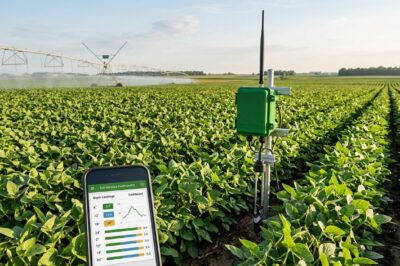
John Deere Field Connect for Soybean Irrigation: System Overview, Pricing, and What to Know Before Buying
Key Takeaways John Deere Field Connect for soybean irrigation is a topic that requires an important clarification upfront: Field Connect was discontinued by John Deere in December 2020 and is no longer available as a new purchase through the John Deere dealer network. Growers researching Field Connect as a potential purchase for their soybean operation…
-

Arable Mark 3: How In-Canopy Microclimate Data Improves Soybean Irrigation Decisions
Key Takeaways Arable Mark 3 soybean irrigation decisions benefit from a measurement approach fundamentally different from conventional weather stations or soil moisture sensors: the device sits directly within the crop canopy and measures both the atmospheric conditions and the crop’s physiological response to those conditions simultaneously. A standard weather station measures the atmosphere; the Mark…
-

Aquacheck Soil Profile Sensors: Multi-Depth Root Zone Monitoring for Soybean SDI Systems
Key Takeaways Aquacheck soil profile sensor soybean SDI deployments solve a specific diagnostic problem that single-depth soil moisture sensors cannot address: confirming whether a buried drip irrigation system is actually delivering water to the full depth of the soybean root zone, or only saturating the immediate area surrounding the tape while deeper roots continue depleting…
-

Irrometer Watermark Sensors: Low-Cost Soil Tension Monitoring for Soybean Irrigation Trigger Points
Key Takeaways Irrometer Watermark sensor soybean irrigation management is one of the most cost-effective entry points into data-driven irrigation scheduling for commercial soybean operations. At roughly $30–50 per sensor, Watermark sensors deliver actionable soil moisture data at a fraction of the cost of capacitance probe systems, and their resistance-based measurement principle produces readings that translate…
-

The Utility of ET Networks for Large-Scale Soybean Operations: ASCE Penman-Monteith Models in Practice
Key Takeaways The FAO-56 Penman-Monteith equation is the universal scientific standard for calculating reference evapotranspiration (ET₀) — the daily water loss benchmark from which all crop-specific irrigation requirements are derived, including soybeans at every growth stage. ET networks — regional arrays of automated weather stations — solve the equation continuously across agricultural landscapes, giving commercial…
-

Weather-Based Irrigation Triggering for Soybeans: How ET Controllers Reduce Over-Watering on Commercial Farms
Key Takeaways Weather-based irrigation triggering for soybeans works by calculating how much water your crop lost each day and only running irrigation when that deficit hits a threshold you set. Instead of a fixed timer that waters regardless of what happened yesterday, an ET-based controller keeps a running soil water balance and pulls the trigger…
-

ET-Based Sensor Networks for Soybean Irrigation: How Evapotranspiration Inputs Replace Manual Scheduling
Key Takeaways An ET sensor network for soybean irrigation scheduling removes the most fundamental weakness of manual and calendar-based irrigation management: the inability to respond in real time to what the crop is actually losing. By measuring the atmospheric and soil conditions that drive crop water demand — continuously, automatically, and at the field level…
-

Sentek Drill and Drop Soil Moisture Sensors: Installation, Calibration, and Data Interpretation for Soybean Farmers
Key Takeaways Sentek Drill & Drop soil moisture sensors for soybean operations give you a continuous, multi-depth picture of what’s happening in your root zone — not a single point measurement, but a depth profile that shows where your crop is extracting water, how fast the root zone is depleting, and when stress is approaching…
-

Infrared Aerial Imaging for Soybean Health Monitoring: Services, Costs and ROI
Key Takeaways Infrared aerial imaging uses two distinct sensor types — multispectral near-infrared and thermal infrared — which solve different problems and should not be used interchangeably. Thermal infrared detects water stress and Sudden Death Syndrome (SDS) by measuring canopy temperature changes before you can see any symptoms in the field. [1] Multispectral near-infrared imaging…
-

Water Usage Analytics for Soybean Farms: Turning Irrigation Data into Higher Yields
Key Takeaways: Water productivity (WP) — the amount of grain you get per unit of water used — is the single most useful metric for measuring irrigation efficiency on soybean farms. Over 60% of total seasonal water demand hits during reproductive stages R1–R6, making that window the highest-priority target for data-driven irrigation decisions. Platforms like…

Follow Us
Recent Posts
- Pressure Compensating vs Non-PC Emitters for Soybean SDI: When You Need PC and When You Don’t

- GPS vs Traditional Pivot Guidance for Soybeans: Accuracy, Maintenance, and Upgrade Economics

- John Deere vs Case IH Irrigation Platform for Soybeans: Operations Center vs AFS Connect and What Each Actually Manages

- T-L Irrigation Pricing for Soybeans: What Drives System Cost and How to Compare Per-Acre Investment

- Pivot Wheel Track Compaction and Soybean Yield: Impact, Measurement, and Management
