
-
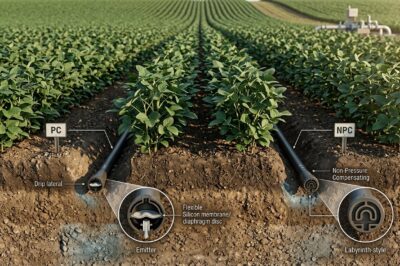
Pressure Compensating vs Non-PC Emitters for Soybean SDI: When You Need PC and When You Don’t
Key Takeaways Pressure compensating vs non-PC emitters for soybean SDI is a hydraulics question with a clear answer in most situations: if your soybean field has meaningful slope along the lateral direction, you need PC emitters. If your field is flat to very gently sloping and your lateral runs are within the hydraulically designed length…
-
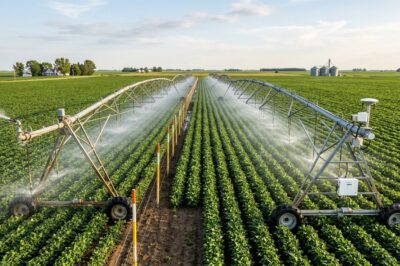
GPS vs Traditional Pivot Guidance for Soybeans: Accuracy, Maintenance, and Upgrade Economics
Key Takeaways GPS vs traditional pivot guidance for soybeans is a comparison where the right answer depends heavily on what type of guidance is being compared and what it’s guiding. For standard circular center pivots without corner arms, GPS adds position data visibility but doesn’t fundamentally change the machine’s path accuracy over correctly functioning conventional…
-
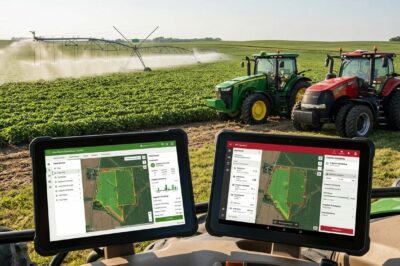
John Deere vs Case IH Irrigation Platform for Soybeans: Operations Center vs AFS Connect and What Each Actually Manages
Key Takeaways John Deere vs Case IH irrigation platform for soybeans is a question that requires one clarification upfront: neither John Deere nor Case IH makes the irrigation hardware. Valley, Reinke, and Lindsay/Zimmatic manufacture the center pivots that irrigate the majority of U.S. soybean acres. What John Deere and Case IH offer are farm management…
-
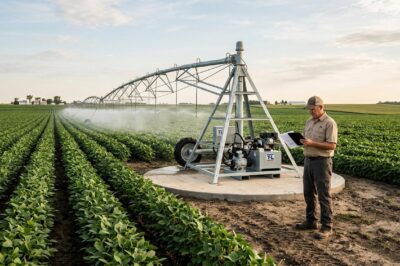
T-L Irrigation Pricing for Soybeans: What Drives System Cost and How to Compare Per-Acre Investment
Key Takeaways T-L irrigation pricing for soybeans is not a number you can look up — it’s a number you get from a T-L dealer after providing your field dimensions, tower count, water supply situation, and desired control options. Like all major center pivot brands, T-L doesn’t publish a national retail price list because system…
-
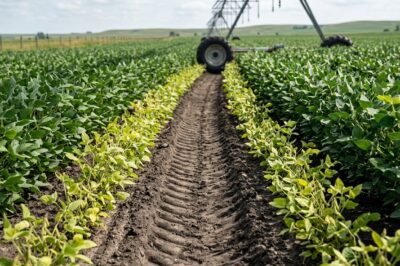
Pivot Wheel Track Compaction and Soybean Yield: Impact, Measurement, and Management
Key Takeaways Pivot wheel track compaction and soybean yield is a topic where the yield data is less alarming than the visible field evidence — severely rutted, waterlogged pivot tracks look dramatic but the whole-field yield penalty from track compaction is typically modest when tracks represent 2–5% of total irrigated acreage. The more important management…
-
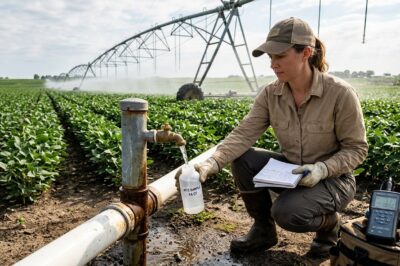
Irrigation Water Quality Testing for Soybeans: What to Test, How to Interpret Results, and When to Act
Key Takeaways Irrigation water quality testing for soybeans answers a question that soil testing and yield mapping can’t: is the water you’re applying a neutral carrier for your irrigation program, or is it accumulating salt, sodium, scale-forming minerals, or clogging agents that are progressively degrading your soil, your irrigation system, or both? For most Midwest…
-
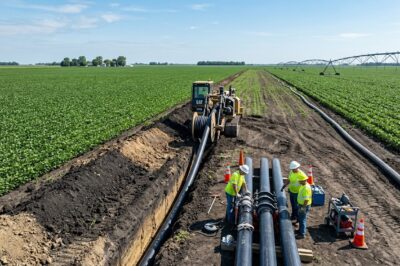
Buried vs Above-Ground Irrigation Pipeline for Soybeans: Material Selection, Installation Costs, and Long-Term Performance
Key Takeaways Buried vs above-ground irrigation pipeline for soybean operations is a decision that looks like a cost trade-off but is actually a service life and field operations trade-off. The upfront cost difference between a trenched and buried HDPE mainline and a surface-laid polyethylene line is real — but the buried line will still be…
-
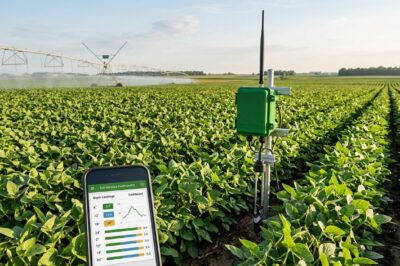
John Deere Field Connect for Soybean Irrigation: System Overview, Pricing, and What to Know Before Buying
Key Takeaways John Deere Field Connect for soybean irrigation is a topic that requires an important clarification upfront: Field Connect was discontinued by John Deere in December 2020 and is no longer available as a new purchase through the John Deere dealer network. Growers researching Field Connect as a potential purchase for their soybean operation…
-
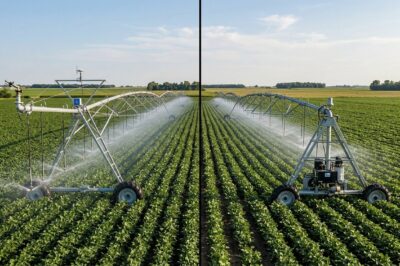
Reinke E3 Electrogator vs T-L Hydrostatic Drive for Soybeans: Uniformity, Technology, and the Maintenance Trade-Off
Key Takeaways Reinke E3 vs T-L hydrostatic drive for soybeans is a comparison that gets conflated with the broader electric-vs-hydraulic debate — but the E3 is a fundamentally different product from conventional electric pivots. The E3’s precision uniform coupler spacing is a structural engineering solution to a uniformity problem that exists in all conventional pivots,…
-
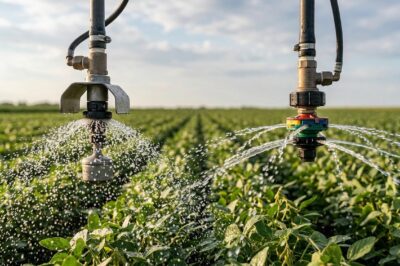
Senninger i-Wob2 vs Nelson R3030 for Soybean Pivot Irrigation: Full Comparison and Selection Guide
Key Takeaways Senninger i-Wob2 vs Nelson R3030 is one of the most common sprinkler selection questions for Midwest soybean pivot operators — and the honest answer is that neither product wins universally. Both are well-engineered, commercially proven sprinklers that deliver adequate uniformity on soybean fields when matched correctly to site conditions. The selection question is…
Follow Us
-
GPS vs Traditional Pivot Guidance for Soybeans: Accuracy, Maintenance, and Upgrade Economics
-
John Deere vs Case IH Irrigation Platform for Soybeans: Operations Center vs AFS Connect and What Each Actually Manages
-
T-L Irrigation Pricing for Soybeans: What Drives System Cost and How to Compare Per-Acre Investment
-
Pivot Wheel Track Compaction and Soybean Yield: Impact, Measurement, and Management