
Key Takeaways
- CropX currently sells two soil sensor lines for row crops: the Vertex (all-in-one, fixed 3-depth design) and the newer Apex (configurable 12/24/36-inch, 4-inch-interval readings), launched in April 2026.
- The Vertex measures soil moisture and salinity at three depths—roughly 8, 16, and 26 inches—with moisture accuracy of ±0.5% VWC, covering the effective root zone for most soybean fields.
- No separate telemetry device is needed for the Vertex; it has built-in cellular connectivity and a rechargeable, field-removable battery. The Apex, by contrast, connects through a separate CropX telemetry gateway (TD2).
- CropX has a direct integration with Reinke’s ReinCloud platform, letting growers running Reinke pivots pull soil data and irrigation control into one interface.
- US pricing for a Vertex unit including first-year platform subscription runs in the $375-400 range through agricultural irrigation dealers, though exact pricing varies by dealer and region.
Article Summary: CropX makes two soil sensor lines relevant to soybean growers—the all-in-one Vertex and the newer, higher-resolution Apex—both feeding into a cloud platform that tracks moisture, temperature, and salinity across the root zone to support irrigation scheduling decisions during critical R1-R6 reproductive stages.
What the CropX Soil Sensor Actually Measures
CropX’s current flagship sensor is the Vertex, an all-in-one probe that measures volumetric water content (VWC) and electrical conductivity (a proxy for soil salinity) at three fixed depths—roughly 20cm, 40cm, and 66cm (about 8, 16, and 26 inches)—with temperature readings at the top two depths.[1] For soybeans, that depth range covers the zone where the bulk of root water uptake happens through most of the season, though very deep-rooting conditions in drought years can pull moisture from below the sensor’s lowest reading point.
Moisture accuracy is rated at ±0.5% VWC across a 0-60% range, with temperature accuracy of ±0.5°C across an operating range of -10°C to 70°C.[1] The unit uses a patented spiral design that CropX and independent reviewers have found reduces preferential water flow along the probe body—a known accuracy problem with straight-shaft soil moisture probes, where water can channel down the installation gap rather than moving naturally through undisturbed soil.[2]
Vertex vs. Apex: Which CropX Sensor Fits Your Field
As of April 2026, CropX expanded its lineup with Apex, a configurable multi-depth sensor available in 12-inch, 24-inch, and 36-inch lengths that takes readings every 4 inches throughout the installed profile.[3] That’s meaningfully higher spatial resolution than the Vertex’s three fixed points—useful if you’re managing sandy fields with fast-draining pockets, or if you want to see moisture movement through the profile in more detail than three snapshot depths provide.
The tradeoff is installation complexity and cost. The Vertex is genuinely all-in-one: no separate telemetry device, a tapered design built for do-it-yourself installation, and a rechargeable battery you can pull without disturbing the sensor in the ground.[4] Apex connects via a standard SDI-12 interface to a separate CropX telemetry gateway (the TD2 unit), which adds a component to source, mount, and maintain.[3] For a typical quarter-section soybean field where you’re placing a handful of sensors to represent different soil zones, most growers will find the Vertex simpler to deploy at scale; Apex makes more sense where you specifically need finer depth resolution in a smaller number of monitoring locations, such as validating a variable rate irrigation zone map.
| Spec | Vertex | Apex |
|---|---|---|
| Measurement depths | 3 fixed depths (~8″, 16″, 26″) | 4-inch intervals throughout 12″, 24″, or 36″ length |
| What it measures | VWC, salinity (all depths); temperature (top 2 depths) | VWC, temperature, salinity at every interval |
| Telemetry | Built-in, no separate device needed | Requires separate TD2 telemetry gateway (SDI-12) |
| Installation | DIY, tapered design, ~5-10 minutes with pilot hole prep | Requires matched tapered auger for full-length installation |
| Best fit | Standard field-scale deployment, multiple monitoring points | High-resolution profile data, VRI zone validation |
Installation for Soybean Fields
Installation follows a straightforward process: drill a pilot hole with the appropriately sized auger bit, add water to the hole and let it infiltrate for a few minutes, then screw the sensor into the pilot hole using the supplied handle until the sensor head sits flush with the soil surface.[5] For soybeans, timing installation before or shortly after planting—rather than waiting until V-stage growth is underway—avoids root disturbance near the sensor and gives you a full growing-season data record starting from emergence.
Sensor placement within the field matters more than sensor count for most soybean operations. A single Vertex placed in a representative “typical” spot in a uniform field can work, but fields with meaningful soil variation—sandy ridges versus clay swales, for example—generally get more useful data from 2-3 sensors placed to represent each distinct soil zone rather than one sensor for the whole field, since a single average reading can mask real localized water stress.
Using CropX Data During R1-R6 Reproductive Stages
The CropX platform’s practical value for soybean growers concentrates in the R1-R6 window, when the crop is most sensitive to water stress and where the depletion-trigger guidance changes from roughly 70% allowable depletion in vegetative stages down to a 50% trigger through the reproductive period. Rather than relying on hand-probing or visual crop stress symptoms—both of which tend to show up after the crop has already been under stress for some time—continuous sensor readings let you catch the depletion trend before it crosses the trigger threshold.
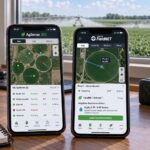
The platform layers weather data and satellite imagery on top of the raw sensor readings to build irrigation recommendations, rather than presenting soil moisture numbers in isolation.[6] For growers already tracking total seasonal water requirements manually, this shifts the workflow from periodic manual checks to a dashboard you can check daily during the highest-stakes weeks of the season.
Integration with Irrigation Controllers
CropX has a direct, named integration with Reinke’s ReinCloud irrigation management platform, allowing growers running Reinke center pivots to combine soil sensor data with pivot control in one interface rather than switching between two separate apps.[7] If you’re comparing Reinke against Valley or other pivot brands and you already know you want CropX sensors as part of your setup, that integration is worth factoring into the decision, since it removes a manual data-transfer step between soil readings and irrigation scheduling.
CropX also positions the soil sensor as one piece of a broader hardware lineup that includes the Evato evapotranspiration sensor, the Strato weather station, and the Rivo rain gauge, all feeding the same platform.[8] Growers evaluating CropX purely as a soil moisture tool should be aware the company’s roadmap is built around this wider system—useful if you’re planning to add more sensing layers over time, less relevant if you only want a standalone soil probe.
Pricing
US pricing through agricultural irrigation dealers puts a Vertex unit with first-year platform subscription in the $375-400 range, though exact pricing varies by dealer, region, and whether you’re buying direct from CropX or through a partner like a Reinke or Valley dealer.[9] Ongoing platform access requires an annual subscription after the first year; confirm current renewal pricing with your dealer since subscription costs are more likely to change year to year than hardware pricing. The Apex sensor is listed separately at approximately $695 through CropX’s own store, before the separate TD2 telemetry gateway required to connect it.[3] Multiply either unit cost by the number of monitoring points you’re deploying—most fields benefit from more than one sensor, which changes the total investment more than the per-unit price does.
Who This Fits and Who It Doesn’t
CropX makes the most sense for soybean operations already comfortable with app-based farm management tools and looking to replace hand-probing or guesswork scheduling with continuous data, particularly on fields with real soil variability where a single depletion estimate for the whole field misses meaningful differences between zones. The Reinke integration is a specific reason to consider CropX if you’re already committed to Reinke pivots or evaluating them.
It’s a less obvious fit for operations wanting the absolute lowest-cost entry point into soil moisture monitoring—simpler tension-based sensors from other manufacturers can cost less per point, though they typically require more manual reading and lack the cloud dashboard and weather/satellite integration CropX provides. It’s also worth checking compatibility carefully if you’re running Valley, Lindsay/Zimmatic, or T-L systems rather than Reinke, since the ReinCloud integration specifically is a Reinke feature rather than something available across all pivot brands.
Conclusion
CropX’s current lineup gives soybean growers two real options depending on how much depth resolution and installation complexity you’re willing to trade off: the all-in-one Vertex for straightforward, multi-point field deployment, or the newer Apex for higher-resolution profile data where you need it. Either way, the platform’s real value shows up during the R1-R6 window when depletion-trigger timing matters most, and the direct Reinke integration is worth weighing if pivot brand choice and sensor choice are both still on the table for your operation.
For more guides on Soil Moisture Sensors, visit the Aguafox soil moisture sensors for soybean irrigation hub.
CropX Soil Sensor FAQs
What depths does the CropX Vertex soil sensor measure?
The CropX Vertex measures soil moisture and salinity at three fixed depths—approximately 8, 16, and 26 inches (20cm, 40cm, 66cm)—with temperature readings at the top two depths. This range covers the primary root zone for most soybean fields through the majority of the season.
Does the CropX soil sensor need a separate telemetry device?
The Vertex does not—it has built-in cellular connectivity and requires no additional telemetry hardware. The newer Apex sensor does require a separate CropX telemetry gateway (TD2), connected via a standard SDI-12 interface.
How much does a CropX soil sensor cost?
US pricing through irrigation dealers typically runs $375-400 for a Vertex unit including the first year of platform subscription, with pricing varying by dealer and region. The Apex sensor lists at approximately $695 before the additional telemetry gateway required to connect it.
Can CropX sensors integrate with center pivot control systems?
Yes—CropX has a direct integration with Reinke’s ReinCloud platform, combining soil sensor data with pivot control in one interface. This integration is specific to Reinke; confirm compatibility separately if you’re running Valley, Lindsay, or T-L equipment.
How many CropX sensors does a soybean field need?
A single sensor can work for a uniform field, but fields with meaningful soil variation—sandy ridges versus clay swales—generally benefit from 2-3 sensors placed to represent each distinct soil zone, since one average reading can mask localized water stress that a single sensor placed in the “wrong” spot would miss entirely.
CropX Soil Sensor Citations
- CropX Technologies, “CropX Hardware – Soil Sensor and Telemetry”; specifications also listed via Instrument Choice, “CropX Vertex All-In-One Soil Sensor (SV4)”
- Precision Farming Dealer, “Soil Moisture Probe Geometry Affects Accuracy, Says CropX Study”
- CropX Technologies, “CropX Expands Sensor Portfolio with Apex, Bringing High-Resolution Root Zone Data to the CropX Platform” (April 2026); pricing via CropX Store, Apex Soil Sensor listing
- CropX Technologies, “Sensors, Telemetry Devices, Gauges” product page
- Mississippi State University National Center for Alluvial Aquifer Research, “CropX Soil Sensor” installation guidance
- IrrigationBox, “CropX Soil Moisture Sensor” platform overview
- Reinke Manufacturing, “CropX Partnership: Reinke’s Advanced Soil Monitoring Solutions”
- CropX Technologies, CropX Agronomic Farm Management System overview
- Roberts Irrigation, “CropX Soil Sensor Vertex V4” product listing




Leave a Reply